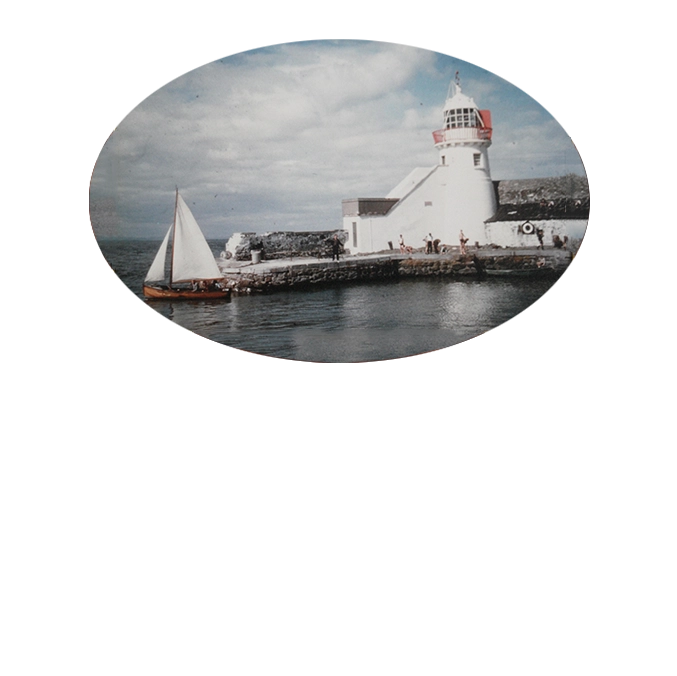
Balbriggan and the Textile Industry
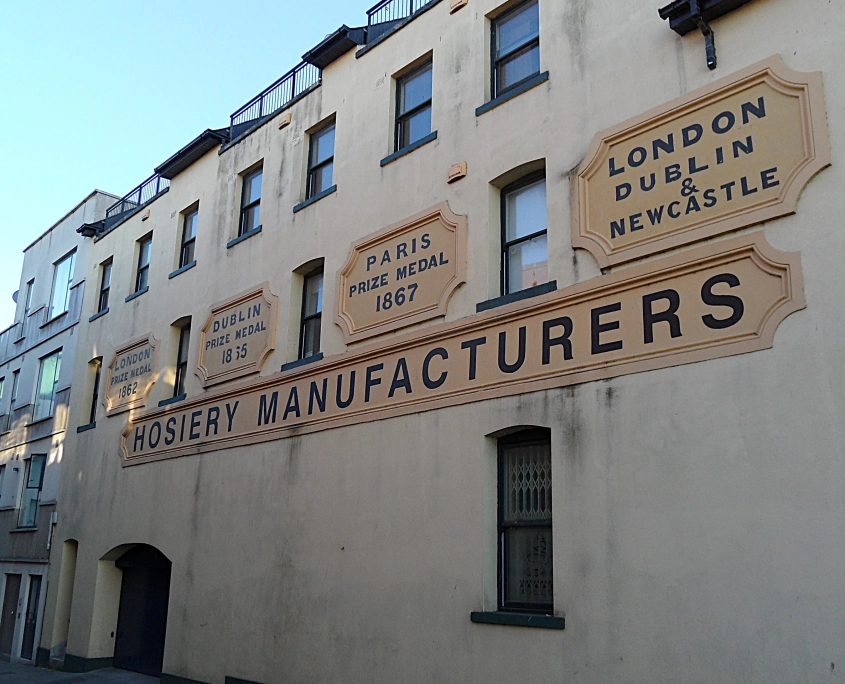
At the turn of the twentieth-century Balbriggan was known around the world for the quality of its textile products. The hosiery and linen industries were central businesses in the Balbriggan area for about 250 years with cotton manufacture introduced to the town by Baron Hamilton in 1780.
Prior to that Balbriggan was a small fishing village overshadowed by the main population centre at Balrothery which had several small manufacturing industries in the eighteenth-century producing basic furniture, tanned products, beer and biscuits. There had been some hosiery manufacturing in Balrothery prior to 1740 but this was largely a cottage industry. In 1740 the hosiery industry was established on a more solid basis but the business lapsed in the 1760s. It was revived shortly after and in 1780 the firm Smyth & Company was established before moving to Balbriggan.
Smyth & Company gradually and steadily gained in reputation and Balbriggan products became known the world over. In the early nineteenth century the company began producing openwork stockings which were to become a favourite of Queen Victoria and the Tsarina of Russia. Smyth & Co. occupied what was known as Upper Mill by 1783.
They were by no means the only textile manufacturers in Balbriggan with the Drogheda Linen Company operating out of Lower Mill on Mill Street. In the 1830s the latter company took advantage of mechanisation and began developing power from water turbines and installing weaving looms from Lancashire. The factory built up a healthy business in bed sheets, pillowcases, tablecloths and mattress coverings. In 1887 the company was bought by Charles Gallen and renamed Charles Gallen & Co and continued operating with marked success into the late twentieth-century.
By the mid nineteenth-century Balbriggan had two thriving large factories powered by a combination of steam engine and waterwheel – together providing 84 horsepower which was sufficient to drive 7500 spindles for spinning the cotton, an average production of 7400lbs per week giving employment to about 300 people.
A millrace, known locally as ‘The Canal’ drove the waterwheel. The presence of a sufficient water supply to drive the machinery was one of the key elements in transforming what had begun as a small cottage industry into a major manufacturing concern. The reservoir (FIHS0183), located to the south of the town, together with an intricate network of natural watercourses such as Tanner’s water and the River Bracken, were augmented by mill ponds and mill races to ensure a supply of water to aid the development of the industries in Balbriggan.
The Bracken River was central to providing a water supply. It was created by a confluence of streams including Tanner’s Water and flowed northwards feeding the reservoir which supplied water for the upper mill, located on Dublin Street. It also supplied water to the Mill Dam (FIHS0184) situated adjacent to Vauxhall Street which fed the lower mill by means of ‘The Canal’.
In 1867 Smyth & Co. built new premises next to the railway station, which had opened in 1844. This new factory contained the most up-to date machinery, but was destroyed by fire in 1882. It was subsequently rebuilt on a larger scale and fitted with the latest machinery. The fire at Smyth & Co. presented opportunities for other firms, who utilised the skilled labour.
An English firm, Deeds, Templar & Co., established a factory near the railway line to the north of the town named Balbriggan Banks Hosiery Company in 1884. The factory was destroyed by the Black and Tans in 1920.