The building of the railway to Balbriggan
In 1836 an act was passed enabling the building of a railway from Dublin to Drogheda. There had been successful lobbying for a coastal route for the railway which would take in towns such as Balbriggan. This would improve transport facilities for the town’s textile industries which were suffering a decline in the 1820s/30s. It was hoped better transport would alleviate this decline.
John Macneill was appointed engineer in charge of the railway and William Dargan and William McGoldrick supervised the work which commenced in 1838 with between 7,000 and 8,000 workers employed on the project. On the first edition Ordnance Survey, the line is shown and annotated Dublin and Drogheda Railway In Progress.
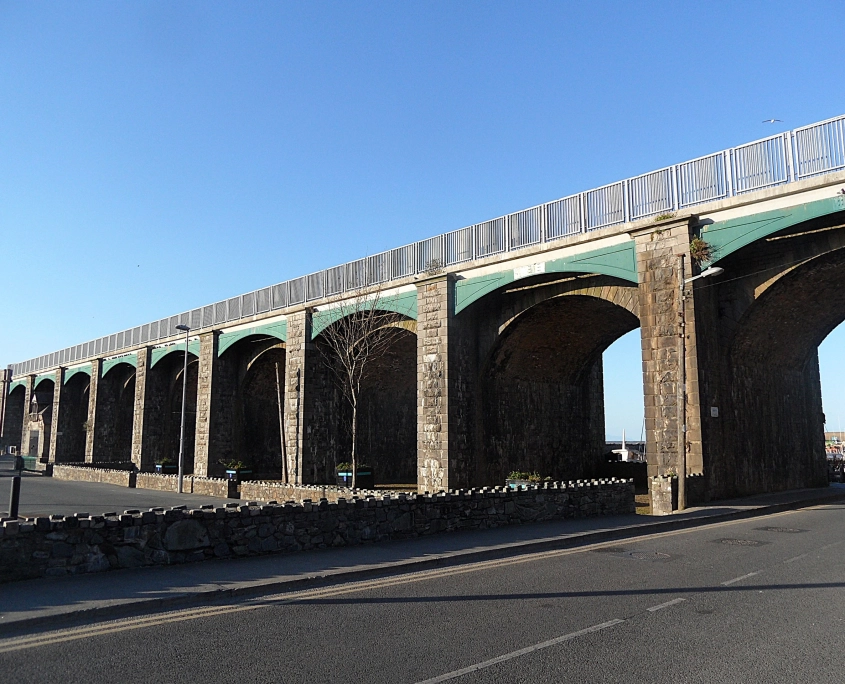
The construction work called for many feats of engineering, much of which can still be seen today. At Ardgillan the track was laid on the route of the old Balbriggan to Skerries road with a new road built to the east of the track. The Balbriggan Viaduct (FIHS0047 – built 1844) was described by Sir John Macneill as the single most important piece of construction on the Dublin to Drogheda project measuring 590 feet across and having 11 arches.
It could only be built with permission from the British Admiralty, given that the water in the harbour used to go back as far as the junction of High Street and Quay Street meaning the viaduct was not just about a railway crossing but also involved considerable land reclamation.
On a site to the west of the Balbriggan viaduct coke ovens were built in order to supply fuel for the train engineers. Coal was sent to Balbriggan from Scotland by sea. Tramways were laid from the quayside to the coke ovens and coal was moved by means of hand propelled carts. The coke ovens fell foul of the navigation authorities who claimed that the glow from the ovens shining through the arches of the viaduct could be mistaken as navigation lights at Mornington and the company decided to brick up some of the arches to prevent this happening.
The viaduct also housed a RNLI Boathouse built in 1889 following a number of ship sinkings.
The Dublin and Drogheda Railway began operating in 1844. Both Balbriggan and Malahide stations were designed by George Papworth. The importance of the railway for local industry is best exemplified at Balbriggan. As Balbriggan was a centre of manufacture, three railway lines went into what is now the station carpark, where the buffer wall of the middle line is still in place today.
There was also a turntable. Goods wagons were lined up, loaded and unloaded, with produce going to and from the factories such as Smyth & Company (Smythco), as well as farmers taking delivery of machinery or selling their produce. On the seaward side of the tracks there was another siding where cattle were loaded for the markets. Balbriggan Railway Station, during the nineteenth-century and for much of the twentieth-century was primarily a goods station.